News
Outdoor AED Cabinets: How To Cover The Hours Your Building Is Locked
Key Takeaway
Your AED passes inspection indoors and is unreachable the moment the building locks. Two communities solved that in the same month. Here is what an outdoor AED cabinet has to do, where to put it, and how to fund it.

Walk your campus at seven o'clock on a Saturday evening and ask one question. If someone on that field went into cardiac arrest right now, could anyone reach your AED?
For most schools, parks and municipal buildings, the honest answer is no. The device is indoors. The building is locked. The fields are full.
This is not a hypothetical gap, and it is not a local one. In November 2026 two communities twenty-five hundred miles apart addressed it in the same three-week stretch, which is usually the sign that something has stopped being an oversight and started being a recognized problem.
The After-Hours Gap, With The Math
Take a typical public high school. The building is open to staff and students somewhere around seven in the morning to three in the afternoon on weekdays. Call it eight hours a day, five days a week, and subtract the summer, holidays and breaks. That is the window in which an indoor AED is reachable by someone who can get to it.
Now count the hours the grounds are in use. Practices run until dusk. Evening games. Weekend tournaments that bring hundreds of visitors onto fields the school does not staff. Rec leagues renting the diamonds. Church softball. Early morning walkers on the track. Community events in the parking lot.
The grounds are in use for far more hours than the building is open, and the extra hours have a second problem layered on top. During the school day there is a nurse, there are coaches, there are trained staff. On a Saturday evening there may be nobody on site who has ever been shown where the AED is, let alone has a key to the corridor it hangs in.
So the coverage gap is not simply a matter of locked doors. It is the hours with the most people and the least trained supervision.
What The Two November Rollouts Did
On November 20, 2026, KEZI reported that Elmira High School, part of Oregon's Fern Ridge School District, installed a climate-controlled outdoor AED cabinet outside its athletic complex. The unit is reachable at any hour. It is registered on the PulsePoint app so that dispatchers and nearby trained bystanders can see it on a map. Opening the cabinet door triggers an alert to school officials and nearby medical volunteers. According to the report, the installation is grant funded through the Sacred Heart Medical Center Foundation and the OCCU Foundation, alongside PeaceHealth and Eugene-Springfield HEARTsafe, and includes eight years of monitoring. The site is roughly twenty minutes by ambulance from the nearest hospital.
Eight days earlier, on November 12, WSB Radio reported that the City of Smyrna, Georgia rolled out more than two dozen AEDs across the city. Six of them sit in outdoor weatherized storage at recreation areas including Village Green Park and Riverview Park, available around the clock. The city's EMS director described the devices as connecting directly with first responders, and the fire chief described the placement as deliberately covering both the north and south ends of the city.
Different states, different funding models, different scales. The same conclusion: the device has to be on the outside of the building.
What An Outdoor Cabinet Has To Do
An outdoor AED cabinet is not an indoor cabinet mounted outside. It has a specific job, and the specifications matter.
Temperature control across your actual climate range. Every AED has an operating and storage temperature range published by its manufacturer. An unheated box in Illinois in January, or an unventilated one in Georgia in August, can push a device outside that range. A proper outdoor cabinet is heated, ventilated or both, and is rated against the temperature extremes your location genuinely sees. Check the cabinet's rating against your device's published range rather than assuming any outdoor-rated box will do.
Weather and ingress protection. The enclosure needs a sealing rating appropriate to driving rain, snow and dust, and UV-stable materials so the housing and signage do not degrade over a few seasons of direct sun.
An alarm and an alert on door open. This serves two purposes. It deters casual tampering, and more importantly it tells someone that the device has been reached. The Elmira installation sends a photo and a text to school officials when the case is opened. That is the feature that converts a box on a wall into part of a response plan.
Signage and visibility. A cabinet nobody notices during an ordinary week is a cabinet nobody finds in an emergency. Use high-contrast AED signage visible from the field and from the approach path, and light it if the location is used after dark.
Sensible mounting height and clear approach. Mount so that the device is reachable by an adult of average height without a step, keep the approach free of landscaping and parked vehicles, and consider accessibility requirements that apply to your facility.
Theft and vandalism realism. Communities that have done this consistently report that theft is rarer than expected, and alarmed cabinets with visible monitoring are part of why. Site the cabinet where it is visible rather than tucked behind a building, and register the serial number so a stolen unit is traceable.
Registration And The Dispatch Map
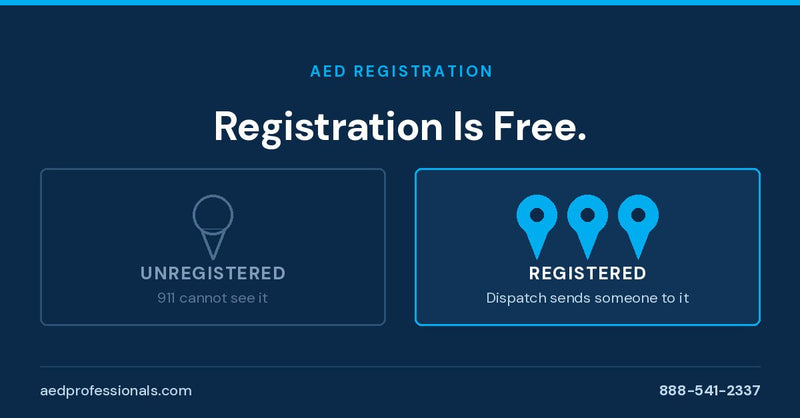
An outdoor cabinet solves the physical access problem. It does not by itself solve the knowledge problem. The dispatcher taking the 911 call still needs to know the cabinet is there.
That is what registration does. The Elmira unit is on PulsePoint, which makes it visible to dispatchers and to nearby CPR-trained app users. Many jurisdictions maintain their own registry, and a growing number of states now require registration outright. Georgia's Mason Sells AED Coordination Act, effective July 1, 2026, requires AED owners to register with both the local EMS agency and the 911 center before a device goes into service.
Register the cabinet when you install it, not later. Then keep the record current, because an outdoor unit is more likely than an indoor one to be relocated during construction or field work. Our guide to AED placement covers the broader siting question.
Where To Put It
Three placements cover most campuses and most municipal sites.
The exterior wall nearest your primary field. This is the highest-value position, because it is the one that covers practices, games and tournaments.
Beside the main entrance. This covers the parking lot, the approach, and anyone who arrives looking for help because they know the building is there.
At the concession or restroom block. On larger grounds this is where people congregate, and it is often the structure closest to the far fields.
The test to apply is simple. Stand at the farthest point of play on your grounds and time a brisk walk to the proposed cabinet and back. Response guidance generally works toward getting a defibrillator to the patient within a few minutes of collapse, so if the round trip from your most distant field is longer than you are comfortable with, you need a second cabinet rather than a better sign.
Funding It
The Elmira installation was grant funded, and that is a more available route than most facilities realize.
Hospital and health system community benefit funds. Nonprofit hospitals have community benefit obligations and AED placement is a well-understood use of them. Start with the foundation attached to your nearest health system.
Community and credit union foundations. Local foundations fund exactly this kind of visible, finite, community-wide safety project.
Parks and facilities capital budgets. An outdoor cabinet is a small line item in a capital request and an easy one to justify in writing, particularly alongside a documented after-hours coverage gap.
Booster clubs and athletic associations. Parent organizations fund equipment that protects athletes, and this is a clearer case than most.
Joint-use agreements. If outside leagues rent your fields, the agreement is a natural place to share the cost of the cabinet that covers their events. Some states are beginning to formalize exactly this relationship between facilities and the youth leagues that use them, as California has started to do.
Maintenance Does Not Change
Moving a device outdoors does not reduce the program obligations attached to it. Pad and battery expiration dates still have to be tracked. Inspections still have to happen on the interval your state or your manufacturer specifies, and still have to be documented. After any use, the device needs new pads and a readiness check before it goes back in the cabinet.
What does change is that you cannot rely on someone noticing a problem in passing, because nobody walks past an outdoor cabinet the way staff walk past a hallway unit. Build the inspection into a schedule rather than into habit. Our articles on AED electrode pads and AED service intervals cover what that schedule should include.
Where To Start
Before you price anything, do the audit. Walk your site at the hour it is busiest and least staffed, note where the people are, and note where the nearest reachable AED is at that moment. Write down the gap in plain terms. That one paragraph is what turns an outdoor cabinet from a nice idea into a funded line in next year's budget.
If you want a second set of eyes on placement, or help matching cabinet specifications to the devices you already own, we have been doing AED program work since 2003. Call 888-541-2337.
Sources: Elmira High School outdoor AED installation as reported by KEZI 9, November 20, 2026. City of Smyrna AED program as reported by WSB Radio, November 12, 2026. Georgia Senate Bill 399, the Mason Sells AED Coordination Act, effective July 1, 2026. This article is general information and not legal advice; confirm enclosure specifications against your AED manufacturer's published operating and storage ranges, and confirm registration requirements with your local EMS agency and 911 center.
Next Step
Ready To Equip Your Location?
Compare AEDs from six authorized brands, or find the pads and battery for the unit you already own.